
 Posted by
 Wa to Nihon – The Japanese Embassy to Tang China in 702
The Japanese envoy to Tang China in 702 was not merely a restoration of diplomatic relations, it was a mission designed to present to the Tang Empire, the new form of the Japanese state, which had been reorganized following its defeat at the Battle of Baekgang in 663AD. “Wa” was changed to “Nihon”, “Great King” (Ōkimi) was changed to “Emperor” (Tennō), and military power was consolidated into the Ritsuryō system, Dazaifu, the new Western Capital, Sakimori border guards in Tsushima, Iki and Northern Kyushu, government roads, and fire beacon systems. The title of Tennō served as a political title that avoided conflict with the Tang Emperor while preventing the monarch from being relegated to the status of a mere “King.” Japanese mythology was also reconstructed to support this authority. The year 702 marks the starting point at which Japan appeared within the international order and “Nihon” and “Tennō” were presented for Tang recognition.
In 702, the Wa state resumed sending envoys to the Tang dynasty after a long hiatus. This embassy was not simply a restoration of diplomatic ties. After the defeat at the Battle of Baekgang, the Wa state had undergone a radical transformation of its national structure. The 702 envoy should be viewed as a mission sent to present this new state formation to the East Asian international order, which was centered around the Tang Empire.
Most significant here is the change of the national name from “Wa” to “Nihon.” A country’s name is not something that can be determined unilaterally within its own borders. Especially in East Asia from the 7th to the 8th centuries, the massive Tang Empire stood at the center of the international order. How a country was recognized by the Tang specifically. The name by which it was known, determined its position within the East Asian world.
Therefore, changing from “Wa” to “Nihon” was not merely a change in name. It meant that the country needed to be recognized by Tang as a new state, different from Wa, the backwater, barbarian state that existed before the Battle of Baekgang. It is believed that the 702 mission carried the message to the Tang court: “We are no longer the traditional Wa, we are a country called Japan,” and sought recognition of this name.
Simultaneously, the issue of the title “Tennō” (Emperor) arises. Before the Battle of Baekgang, the leader of the Wa state was the Ōkimi (Great King). The Ōkimi was a king who unified the powerful regional clans (gōzoku) within Wa and held the authority to mobilize military force as needed. In fact, the Wa state sent a large army to the Korean Peninsula to aid Baekje. This demonstrates that the Ōkimi power of that time held enough strength to move troops across the sea. However, after the defeat at Baekgang, this Ōkimi authority had to undergo a major transformation.
Under pressure from the Tang and Silla, the Wa state could no longer remain a kingship that unified the military power of the clans to venture across the sea as it had before. In particular, the maritime military power of Kyushu was a dangerous force for the central government, as it possessed the potential to move independently once again.
Therefore, the institutions established after Baekgang, the sakimori border guards, fire beacons, Mizuki (water gate), Ōno-jō (fortresses), Ki-jō (fortresses), the Dazaifu, government roads, and the military unit system, should not be viewed merely as a national defence system. While they were ostensibly defensive measures against Tang and Silla, they were simultaneously mechanisms for the central government to collect and manage military power that had previously moved across the sea, incorporating it into the Ritsuryō state system.
Here lies the shift from Ōkimi to Tennō. The Ōkimi was a king who moved the army. Tennō was a monarch who confined the military within a system. The difference is significant.
Tennō is not a title that simply indicates a stronger version of an Ōkimi. It is highly probable that it was a title reconstructed to reorganize the Ōkimi, formerly a military chieftain, into the systems of Ritsuryō law, rituals, bureaucracy, and document based administration. In other words, the Tennō was created not as a king who leads an army to attack abroad, but as a monarch who institutionally manages military power within the country.
So, why was the title “Tennō” chosen? One could not call oneself “Emperor” (Kōtei) before the Tang Emperor. That would imply equality with the Tang Emperor, which was far too dangerous for the defeated Wa state. However, one could not revert to “King” (Ō) either. To be a “King” would risk being treated as a subordinate monarch within the Tang’s tributary order. “King of Wa” would be nothing more than an extension of the old Wa state. “Great King” (Ōkimi), while functional within Wa, was insufficient as a title within the Tang-led international order. Thus, was it not “Tennō” that was derived to solve this?
Tennō is not an Emperor.
It is not a King.
It is not a Great King.
It is not exactly the “Heavenly Emperor” (Tennō Taitei) found in Chinese astronomical thought either.
Rather, it is thought that “Tennō” was a politically coined term, crafted by the Wa state as a new title for a terrestrial monarch while drawing upon such Chinese vocabulary and astronomical philosophy. In Chinese astronomical thought, there is the concept of “Tennō Taitei.” This is a deity belonging to the celestial order of the North Star, the Purple Forbidden Enclosure, and the Curved Array, said to govern the spirits and hold the map of the myriad deities. In short, it is the highest divinity that governs the gods of heaven.
However, the term used by the Wa state was not “Tennō Taitei,” but simply “Tennō.”
One might perceive careful calibration here. If they had used “Tennō Taitei” itself, it would have been too “imperial” and risked conflict with the order of the Tang Emperor. Yet, “King” was too low, and “Great King” was too reflective of the old Wa. Therefore, “Tennō” was likely chosen as a title that avoided calling oneself an Emperor, did not fall to the level of a King, and yet possessed celestial and ritualistic authority.
In other words, rather than a title meant to oppose the Tang Emperor, “Tennō” was likely a title derived to ensure the monarch was not relegated to a King while avoiding conflict with the Tang Emperor within his international order.
This is also where the composition of Japanese mythology becomes relevant. If the Tennō were to stand at the “center of heaven” himself, that would overlap with the cosmic order of the Chinese Emperor. The Tang Emperor was also a figure who ruled the world under the Mandate of Heaven. Therefore, if the Japanese monarch stood directly at the center of heaven, it would imply a claim to the same position as the Tang Emperor.
This is why, in Japanese mythology, the “center of heaven” was not occupied by the monarch, but placed at a higher level of the myth.
Gods of Takamagahara (the High Plain of Heaven), such as Ame-no-Minakanushi no Mikoto, Takamimusubi, and Amaterasu Omikami, are positioned there, and the Tennō on earth is constituted as an entity that receives the order of that celestial realm. Takamimusubi, in particular, is important. He is the god who holds the command authority of the heavens during the Descent of the Heavenly Grandchild, representing the political center of Takamagahara, a fact that cannot be explained by Amaterasu alone.
Through this structure, the Tennō does not claim, as the Tang Emperor does, that “I myself am the center of heaven.” He is positioned as a ritualistic monarch who receives the order of the celestial gods and realizes that order on earth.
Here, too, we can see the ingenuity of trying to secure authority higher than that of a King while avoiding direct conflict with the Tang Emperor. The 702 embassy to Tang was an act of presenting this restructured state form to Tang.
Wa becomes Nihon.
Ōkimi becomes Tennō.
The military power of the clans was reorganized into the Ritsuryō military system. The maritime military power of Kyushu was managed through sakimori, the Dazaifu, government roads, and fire beacons. Mythology was reconstructed to position the Tennō within the celestial order.
Therefore, 702 is not merely a year of diplomatic resumption. It was the year the Wa state, having been defeated at the Battle of Baekgang, first presented to the outside world the new form of state it had constructed to survive within the international order of Tang.
In other words, the 702 embassy was a mission intended to have Tang recognize the national name “Nihon” and the sovereign title “Tennō.” Herein lies a major starting point for the state of Japan.
Merely naming oneself “Nihon” internally does not make one “Japan” within the East Asian world. By presenting it to the Tang and having it recognized, or tacitly accepted. “Nihon” finally appeared within the international order.
In that sense, 702 was the year Japan was registered to the East Asian world as Japan. The points touched upon, in this short article are but fragments. I look forward to researching more.
Stu
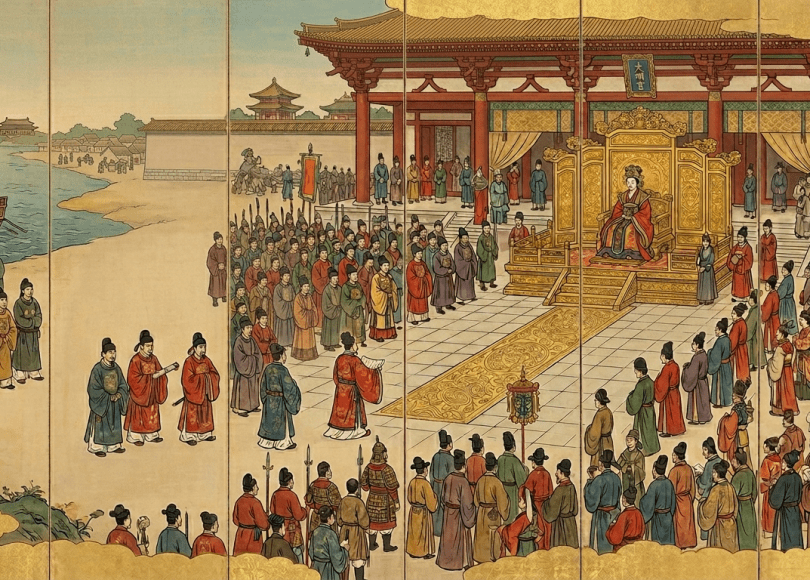
Image created by AI based on the article text.
Source material
The History of Wa by Usatsuhiko Kiyotomo.


You must be logged in to post a comment.