
 Posted by
 Cleaning up some old USBs I found a word doc I didn’t remember so I opened it. To my surprise this is what was on it. Yeah! I vaguely remember writing it but no idea where the info came from. So anyway, here we go.
What was travel like during the Edo period? Well for the most, travel by commoners was prohibited by the laws of each feudal domain, but there were loopholes. Messengers were allowed to operate between post towns and people who carried a seal were also allowed to move between cities for official business. Otherwise, another way was called hot spring therapy which was recognised as a form of treatment for healing illness or injury. And an unusual way to travel was visiting the Ise Grand Shrine. The shrine was the official Imperial Family shrine which incidentally, also represents the nation. It was considered a place where every citizen had the right to pay their respects. As the authorities had no choice but to grant permission if an application was submitted under these pretexts, it can be said that the law was not strictly enforced.
The nationwide boom of Okagemairi.
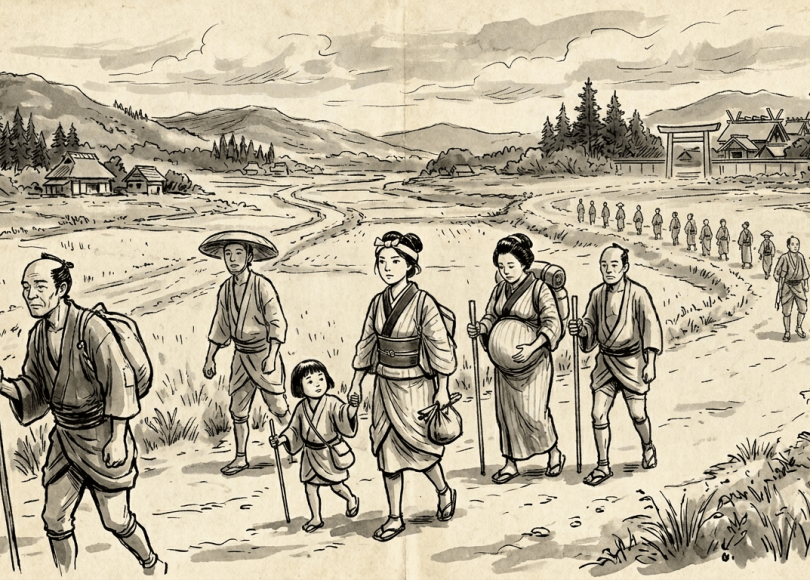
In the late Edo period, as the 1800s began, travel became more accessible to the common people. One of the catalysts for this was the nationwide boom in group pilgrimages to Ise, known as Okagemairi. Poor farmers could reach Ise by simply joining the flow of the crowd heading for Okagemairi, even if they were penniless and travelling with nothing but the clothes on their backs. It is surprising to note that women travelling alone were not uncommon, and that children and pregnant women were also among the pilgrims. A great story I read was a Shikoku Pilgrimage of Takamure Itsue in 1918. More modern than we are talking about with this article, but a good read about a young lady taking on a famous pilgrimage.
Beginning in the third year of the Keian era (1650), the Okagemairi was most actively practised during the Okage years, believed to occur roughly every 60 years when the shrine’s divine blessings were said to be particularly potent. Stories of people finding happiness after visiting Ise Jingu, such as incurable illnesses being cured or businesses flourishing had spread far and wide. Consequently, many people set out for Ise not merely for tourism, but because they genuinely believed these rumours.
In reality, the periods when these pilgrimages became a boom, did not follow a 60-year cycle, the intervals varied irregularly, ranging from 10, 20, or 50 years.
When these events took place, shops along the route would prepare food and straw sandals to distribute free of charge to the pilgrims, and those without money would accept these gifts. Witnessing such generous hospitality, it is thought that the atmosphere felt like a festival involving not only the pilgrims but also the local people.
At its peak, the number of pilgrims to Ise accounted for over 10 per cent of the total annual population, and records indicate that on a single day, nearly 150,000 people visited Ise.
Just how long was the Tōkaidō, the route taken on the pilgrimage to Ise?
During the reign of the first shogun, Ieyasu, the shogunate established 53 rest stops, known as shuku, along the Tōkaidō route (57 if extended to Osaka). These rest stops are also known as shukueki, though the term shukuba (Post Station or Post Town) is perhaps more familiar.
The Tōkaidō stretched from Edo through Owari to Kyoto, covering a distance of 126 ri and 6 chō, which is approximately 494 km when converted to the metric system. As the route was frequently altered over the years for maintenance and other reasons, this figure varies depending on the source.
The relationships between the units of length used at the time and their conversion values are as follows:
1 ri = 36 cho = approx. 4 km (3,927 metres)
1 cho = approx. 109 metres
The distances between post stations varied considerably, some were more than 16 km apart, taking about half a day to walk, whilst others were less than 2 km apart, a journey of just a few minutes if one ran.
It is said that travellers in the Edo period walked around 30 to 40 km a day. As the distance between post stations averaged only about 3 to 4 km, unless the post stations were extremely far apart or there were difficult stretches along the way, it was a distance that even modern people, who are generally less fit than their Edo-period counterparts, could easily cover.
Measuring the length of the Tōkaidō using the shogun’s height.
The average height of an adult male in the late Edo period is said to have been 155 cm. The heights of the successive shoguns were as follows: First Shogun Ieyasu, 159 cm, Second Shogun Hidetada, 160 cm, Third Shogun Iemitsu, 157 cm, Fourth Shogun Ietsuna, 158 cm, Fifth Shogun Tsunayoshi, 124 cm, Sixth Shogun Ienobu, 156 cm, Seventh Shogun Ietsugu: 135 cm, Eighth Shogun Yoshimune: 156 cm.
End
Stu.


You must be logged in to post a comment.