
 Posted by
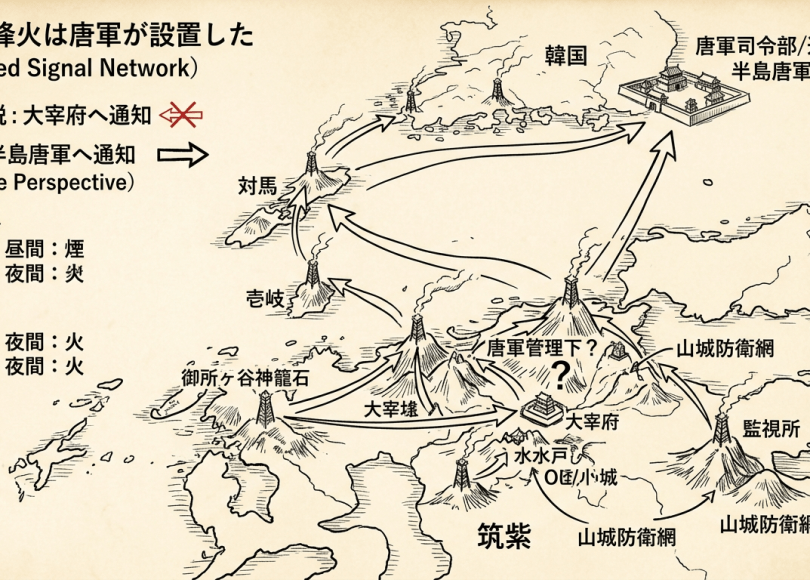
 An interesting look at the Kyushu mountain top fire signal network by local researcher Usatsuhiko Kiyotomo.
The signal fire network was established by the Tang Army.
While illustrations often show these fires alerting Dazaifu, he has a theory that it is likely the opposite. These signals were notifying the Tang forces on the Korean Peninsula.
The Mystery of the Military Network in Northern Kyushu Post-Hakusukinoe.
According to the Nihon Shoki (Tenji, Year 3), just one year after the crushing defeat at the Battle of Hakusukinoe, “border guards and signal fires (tobuhi)” were established in Tsushima, Iki, and Tsukushi. These signal fires were a military communication system designed to transmit warnings of approaching enemies at high speed.
The crucial point here is the timing. The Wa (Japanese) state had just suffered a catastrophic loss and was under intense military pressure from the Tang-Silla alliance. Despite this, a wide area military communication network was supposedly being organized by the following year.
This raises a fundamental question: Was the Wa state truly functioning as an autonomous nation capable of building such a network on its own authority during this period?
Anomalies in the “Self-Defense” Narrative.
The conventional theory suggests that Wa built these defenses in Northern Kyushu for self protection. However, the actual archaeological remains tell a highly unnatural story.
Extreme Concentration: Massive military and administrative facilities around Dazaifu, the Mizuki embankment, Ono Castle, Kii Castle, the Kogo-ishi style mountain castles, and the Goshogatani ruins are all clustered exclusively in Northern Kyushu.
Technological Isolation: The “Kogo-ishi” style castle technology is limited to Northern Kyushu and the Seto Inland Sea coast. It was never passed down to later Japanese castle-building traditions. This suggests these were not permanent national defense structures, but a specific military system tailored only to the geopolitical crisis of the late 7th century.
The Disconnect from Asuka: If a powerful central government in Asuka (Yamato) had led this national defense effort, these networks of signal fires, mountain castles, and military roads should show clear continuity leading toward Yamato. In reality, the system is almost entirely self-contained within Northern Kyushu.
Reinterpreting the Evidence: A Tang-Led Governance?
What does this mean? It is highly probable that immediately after the defeat at Hakusukinoe, the actual center of military administration was not in Yamato, but in Kyushu. This would have been a provisional emergency government under Prince Naka no Ōe, operating under heavy pressure from the Tang.
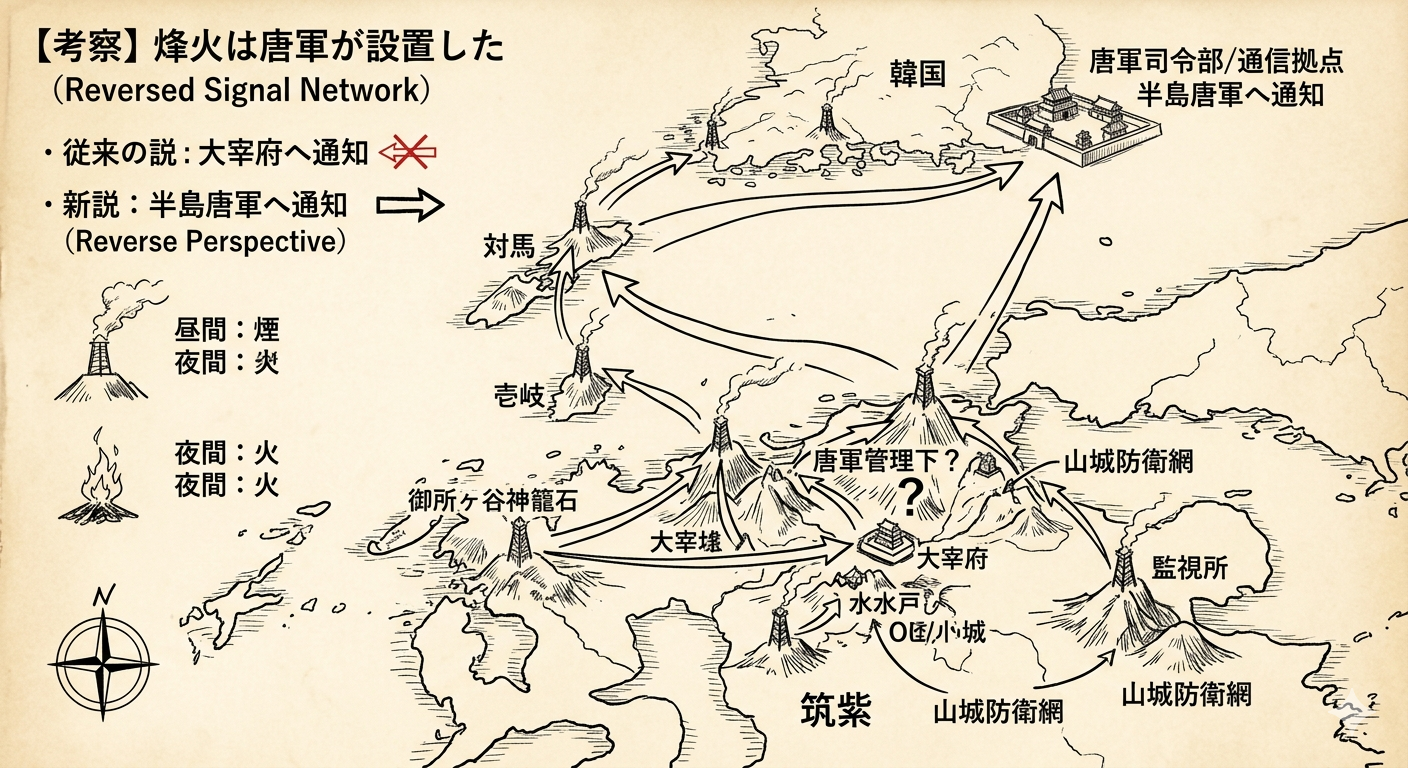
The Hypothesis: These signal fires were not defensive installations built by an independent Wa state. They were likely a military communication network installed within a Tang-controlled administrative framework to monitor and govern Northern Kyushu.
The ruins of mountain castles, government offices, roads, and ports remaining in Northern Kyushu should be re-examined as traces of this occupational or supervisory structure.
Stu.


You must be logged in to post a comment.