
 Posted by
 The Emishi Spoke Ainu
Many place names derived from the Ainu language remain in the Tohoku region, particularly in its northern half.
Place names are often called “living fossils” because they preserve the language, culture, and geographic perceptions of the people who once lived there, tending to persist even as eras change.
In ancient times, a people known as the Emishi inhabited the Tohoku region. Their language was referred to as Igo (meaning barbarian language), and because it was distinct from the Japanese language spoken by the Yamato imperial court, interpreters were required.
As the Yamato court expanded its influence, the Emishi were gradually pushed northward. However, in the northern part of Tohoku, imperial control remained incomplete until the Heian period, allowing the Emishi to maintain their own power.
A Significant Correlation
What is particularly noteworthy is that the regions where the Emishi lived for a long time overlap significantly with the areas where Ainu-derived place names are concentrated.
Why do so many Ainu-derived place names remain in northern Tohoku? The reason is clear. A delay in colonization by the Yamato court. Also, the region remained outside of direct imperial control for a longer period, the indigenous languages and cultures were preserved. Consequently, place names derived from the language of the Emishi survived to later generations.
Therefore, it can be concluded that the language of the ancient Emishi of Tohoku was either Ainu itself or a language extremely close to it.
Beyond Place Names
The traces of the Ainu language are not limited to geography. Vocabulary derived from Ainu also remains in the language of the Matagi, the traditional mountain hunters of Tohoku. This serves as crucial evidence that an Ainu-related language was once widely distributed across the northern part of Honshu.
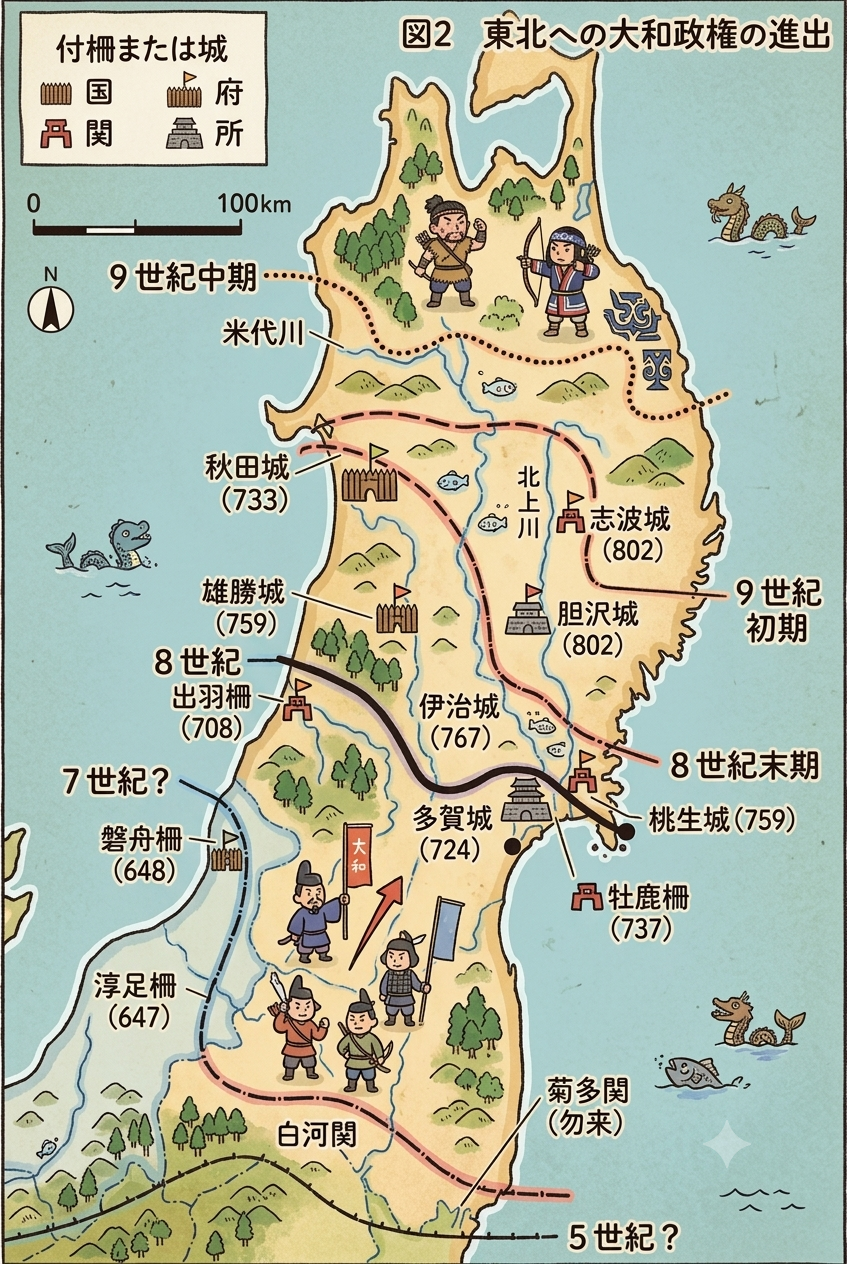
One man also added to the conversation which confirms this theory. I was born and raised right on this linguistic border. The area north of this line is where the ancient form of the Japanese language survives. Everything, including vowel pronunciation, intonation, and vocabulary is completely different from the regions to the south. In fact, there are 25 distinct vowel sounds in this northern dialect, making it impossible to accurately represent in Hiragana or Katakana.
Sakanoue no Tamuramaro came to Tagajo as the Seii Taishogun (Commander-in-Chief of the Expeditionary Force against the Barbarians), and to this day, that location remains the definitive linguistic dividing line.
While the Sendai dialect is often grouped as a single entity, it is actually divided into three distinct categories. Following the rapid standardization of the language within Sendai city shortly after the second world war, the shift in speech becomes instantaneous the moment you cross the border between Sendai City and Tagajo City.
To illustrate how stark the difference is, the two are so mutually unintelligible, and the ways of expressing thoughts are so fundamentally different, that they really should be classified as entirely separate languages.
Having been born and raised on this border, I am bilingual in both languages. However, because these languages are not understood once you cross that line, I have never once spoken in the local dialect while inside Sendai city, just south of the border.
Japan continuously amazes me.
Stu


You must be logged in to post a comment.