
 Posted by
 Wei Zhi Distance-Estimation Method (Part 14)
Reconsidering the Statement “Circling Over 5,000 Li”**
The Wei Zhi contains a crucial geographical statement that has received surprisingly little attention in most modern interpretations. The passage reads:
「参問倭地 周旋五千余里」
“They inquired about the land of Wa, which extended end-to-end for more than 5,000 li.”
In this context:
- 参問 means “to inquire” or “to question directly.”
- 倭地 refers to the territory ruled by the Wa king/queen who received the gold seal recognizing him as the “King of Wa Friendly to Wei.”
- 周旋 should be understood as “from one end to the other,” that is, the full span of the territory.
The text therefore suggests that the Wei envoys confirmed the extent of the Queen’s domain and recorded its total span as over 5,000 li (equivalent here to approximately 385 km).
Common Misinterpretations
1. Interpreting 周旋 as “the perimeter of the country”
Some scholars translate 周旋 as meaning the “circumference” or “perimeter” of the land. This interpretation is not supported by Chinese geographical writing conventions.
In ancient Chinese records, territorial dimensions are typically expressed as:
- 方〇〇里 (“〇〇 li square”), or
- 東西〇里、南北〇里 (“east–west〇 li, north–south〇 li”).
Descriptions based on a measured perimeter are essentially unknown. Measuring a perimeter would require a level of mapping and surveying that would have been extremely difficult in mountainous terrain and across sea routes.
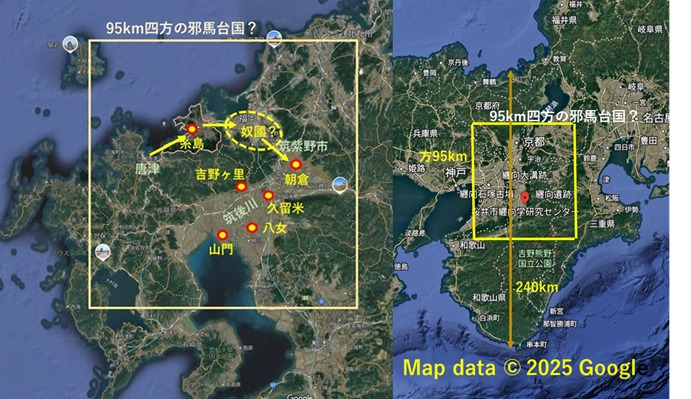
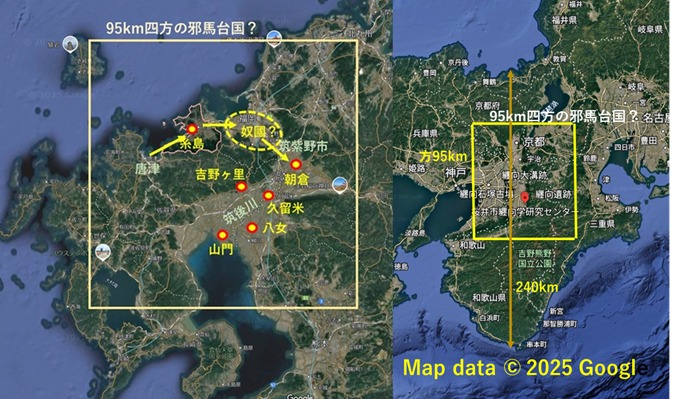
Even if “perimeter” were intended, a perimeter of 5,000 li would imply a roughly 95 km by 95 km region. Such measurement would have been impractical in a landscape dominated by mountains and waterways, and it would not have been feasible using estimation techniques such as the so-called “one-sun, thousand-li method.”
2. Interpreting 5,000 li as a simple remainder from the total journey
A widely accepted theory claims that “Wa territory” simply refers to the final segment of the overall route described in the Wei Zhi.
The full journey is recorded as 12,000 li. If one subtracts the 7,000 li distance to Kaya (狗邪韓國), the remainder is exactly 5,000 li. Thus, some argue that “Wa territory” refers to the travel distance from Kaya onward.
However, this interpretation is logically weak. If the figure were merely the result of a straightforward subtraction, there would have been no need for the Wei delegation to “inquire” of the Wa people. The explicit use of 参問 implies that the information was obtained through questioning rather than calculation.
3. Interpreting 5,000 li as “long-li” (over 2,000 km), meaning the full Japanese archipelago
Another interpretation treats the 5,000 li figure as a different unit (so-called “long-li”), yielding a distance of roughly 2,075 km. From this, some conclude that the figure represents the entire length of the Japanese archipelago.
This is implausible. Measuring the entire length of Japan would have been impossible at the time, and in any case the distance from the southern tip of Kagoshima to Wakkanai is only about 1,869 km. Moreover, political control in this period did not extend to Hokkaido.
Most importantly, there is no reason to assume that the Wei Zhi would employ different li standards within the same document. Such inconsistency would be highly unusual.
A More Plausible Interpretation: Inquiry into the Queen’s Political Domain
The key to understanding this passage lies in the meaning of 参問. The term does not indicate that the Wa people provided a numerical li distance—indeed, later Chinese sources such as the Sui Shu explicitly state that the Wa did not possess a formal concept of distance measurement in li.
Rather, the Wei envoys likely asked the Wa informants a different question: where the Queen’s domain began and where it ended.
In other words, they did not ask “how many li is it?” but instead “from where to where does the Queen rule?”
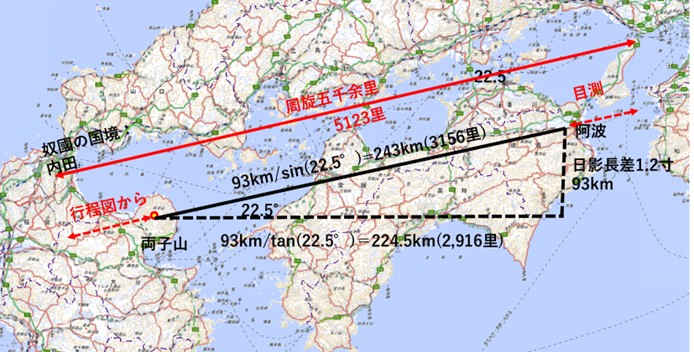
As argued in Wei Zhi Distance-Estimation Method (Part 11), the Wei mission constructed a travel route diagram and used it to estimate distances. Using such a diagram, they calculated the distance from Mount Futago (両子山) on the Kunisaki Peninsula to Awa (阿波).
The Wei Zhi also states that Na-koku (奴國) represented:
“the place where the boundary of the Queen’s territory ends.”
This suggests that the western limit of the Queen’s territory corresponded to the border region of Na-koku, identified here as Uchida (内田).
For the eastern boundary, the envoys likely learned that it extended as far as Awaji Island (淡路島).
The distance from Uchida to Awa could be estimated using their travel map, while the distance from Awa to Awaji Island could be approximated by direct observation across the sea.
Thus, the “Wa territory” referred to in the phrase “circling over 5,000 li” should be interpreted as spanning from Na-koku to Awaji Island.
A diagram illustrating this interpretation is provided in the attached figure.
Geographical Implications
If the Queen’s domain spanned over 5,000 li (approximately 385 km), it exceeds the scale of Kyushu alone (approximately 320 km north–south). It also exceeds the width of the Makimuku region from the Sea of Japan side to the Pacific side (approximately 230 km).
This indicates that the political domain described as “Wa territory” was extensive, surpassing the scale typically assumed in many reconstructions.
Supporting Evidence: Yamatai as a Confederated Political Unit
Further evidence regarding the Queen’s dominion can be found in a passage believed to preserve wording from the original source of the Wei Zhi, namely a quotation attributed to Wang Shen’s Book of Wei (王沈の魏書). It reads:
“Arriving at Yamatai-koku: 70,000 households.
This is where the Queen resides.
Officials are established there, called Ikima (伊支馬)… and next Nukatei (奴佳鞮).
There are 21 subordinate small countries, all ruled by the Queen.”
This passage suggests that Yamatai-koku should not be understood narrowly as a single settlement or city-state. Instead, it was a political structure consisting of the Queen’s central domain plus twenty-one subordinate polities, all under her authority.
In this sense, “Yamatai-koku” represents a confederated realm, and the “Wa territory” described in the Wei Zhi corresponds to this broader sphere of control.
Translated by Stu from Japanese
 Let's Dive into Japanese History
You must be logged in to post a comment.