
 Posted by
 Sirens blazed in the middle of the night.
It is a night I will never forget.
I woke up thinking I was in a dream but I soon realised it was real.
I could see the wings of the B29s all lined up under the glare of search lights. Volleys of anti aircraft gunfire filled the air from the Hakozakihama (Kaizuka) and Hirao (Minami Park) gun emplacements. But I did not see any hits on the planes. I thought the planes might have been higher than the anti aircraft could reach.
After graduating from the second elementary school in Kawasaki gun, Tagawa, I enrolled in Fukuyo Fukuoka Junior High School in April 45. It was a time when people from the city were being sent out to the countryside. I rented a room in Nakajima cho, Higashi Nakasu and live alone.
I remembered air raid warnings going off daily but as yet we had not suffered any bombing. I enjoyed daily life and remember catching fish in the Naka river with my friends.
I was half asleep when the sirens once again bellowed, but I was not worried so I tried to get back to sleep. A short time later though, I heard loud banging on my door. Startled, I quickly opened the door and there stood the head of the neighbourhood association. A small older man who looked like a ghost. I rushed outside to see the western sky, crimson red in colour, covered in smoke and flames.
One after the other, B29s appeared out of the dark dropping their bombs of fire and disappearing back into the night sky. I managed to run to our small air raid shelter as I heard the bombs coming with a high pitched hissing sound eventually exploding with a wall of fire. One bomb rolled into our shelter, so we all ran out to escape the fire, but there was nowhere else for us to go. In those days the streets of Hakata were paved with wooden bricks. All this wood, highly flammable were engulfed with fire instantly. The heat from the bombs was so intense that our clothes would catch fire instantly. I saw many people jumping into the river, there was no where else to go so I also jumped into the river. We were lucky, the tide was on the way out and the wind was also blowing out to sea. There was a lot of debris and oil also in the river so it was difficult to stay afloat. I will never forget seeing the neighbouring neighbourhoods of Shimokawabata and Nakajimabashi fully in flames and destroyed. It is not something I can express in words, verbally or on paper. I saw people floating in the river holding futons, so I tried to swim over to them. It was a long four hours, and the fires gradually died down just as dawn broke.
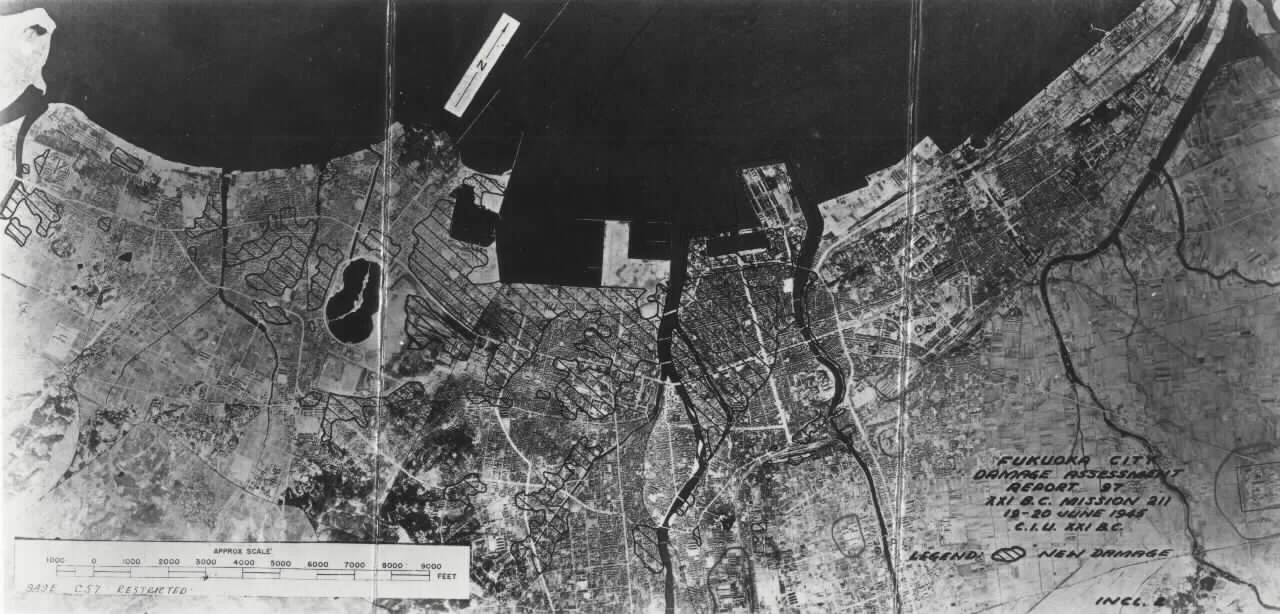
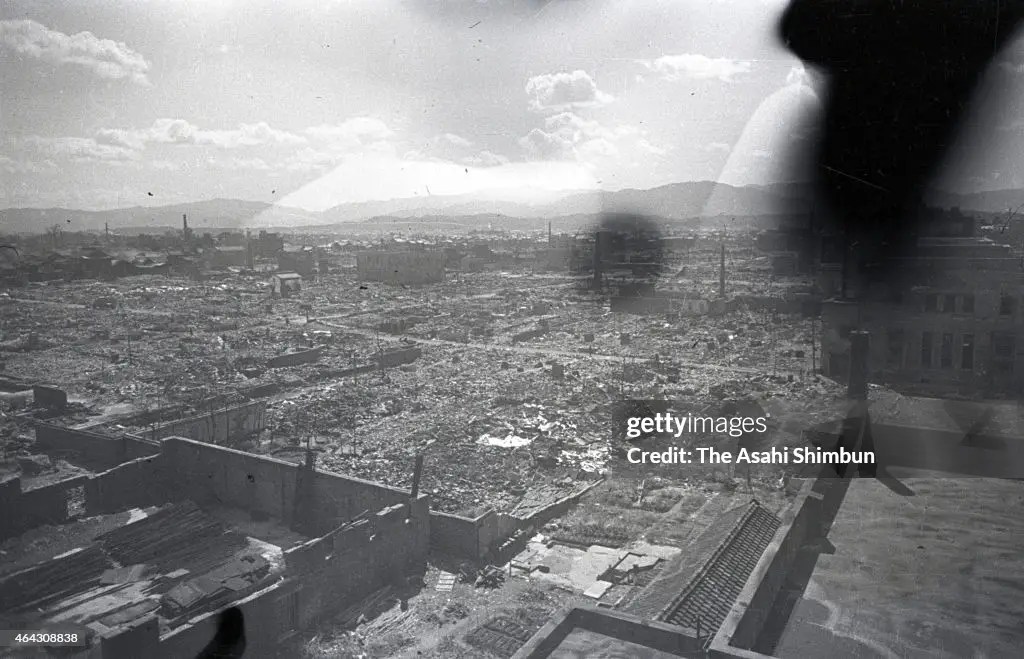
When the light of day arrived, we could see the city of Fukuoka, a burnt wasteland of what was once a beautiful little harbour city. The devastation was seen from Nishi Koen in the west to Hasuike Pond in the east. Reizei Park in the south to Chikko Port in the north. The Nara Elementary school was gone, as was the Jugo Bank and Matsuya building as well as many other building left half standing covered black from the fires.
I found my friend, Tamaya standing alone. His clothing burnet and hanging off him. I yelled to him but I realised he couldn’t really see, his hands and face were burnt. I took him down to the city hall to get his wounds treated and get some food and water. On the way to city hall, the scene I saw was terrible, like something out of a black and white sumi-e painting.
Notes on the 19th June Fukuoka Air Raid.
On the 19th June, B29s took off from the Marianas on a mission to Kyushu. Flying north from the southern Kyushu coast, reaching Fukuoka airspace at about 11:10PM. Fukuoka was the administrative and commercial capital of Kyushu a hub of railways and factories. An estimated 221 B29s began their bombing runs from around 11:10pm and the final plane passed Fukuoka airspace at about 1:00am on the 20th. The 2 hour raid left the two major districts, Hakata and Tenjin completely destroyed.
The affected area was an estimated 3.78km2 which had about 12,693 homes. Fukuoka’s population before the raid was 60,599. After the raid, 902 people died, 1078 injured and 244 missing. Buildings including, schools, factories, military facilities, shopping arcades and houses were set ablaze and destroyed. Also, public services such as water, gas and electricity facilities were also damaged or destroyed. It is estimated that 22% of the city was destroyed.
Before this raid primarily targeting the city centre Fukuoka had been a target for US air missions since late May. Fukuoka harbour was targeted as part of the concurrent large-scale aerial minelaying campaign. The first such undertaking against the harbour took place on 25 May 1945, when 15 B-29 bombers of Colonel Henry C. Huglin’s 9th Bombardment Group were despatched, and 14 of the bombers laid mines. All the bombers returned to base. The same group dropped more mines off Fukuoka harbour on 27 May. Fukuoka harbour was targeted once again in June. On 7 June, 10 B-29 bombers of Colonel Robert A. Ping’s 505th Bombardment Group were despatched, and six of the bombers laid mines. Eight aircraft of the 505th Bombardment Group dropped more mines off the city on 15 June. The 505th Bombardment Group struck again on 23 June, with nine B-29 bombers laying mines. One of the aircraft was lost during the operation. Additional operations were undertaken in July. On 13 July, three B-29 bombers of Colonel Kenneth H. Gibson’s 6th Bombardment Group were sent to lay mines near Fukuoka harbour, but it is not known how many of the aircraft actually laid their mines. Another minelaying operation was undertaken by six B-29 bombers of Colonel Glen W. Martin’s 504th Bombardment Group on 29 July, but again the number of aircraft which dropped their payloads is not known.
Fukuoka was also attacked twice by US fighter aircraft. On 23 June, Republic P-47 Thunderbolt single-engined fighter-bombers of Major General Thomas D. White’s 7th Army Air Force attacked an airfield at Hakata in the Fukuoka area, and North American P-51 Mustang single-engined fighter-bombers of Major General Ennis C. Whitehead’s 5th Army Air Force attacked Fukuoka harbour on 3 July, destroying several floatplanes.
On 17 July a B-29 aeroplane of Colonel George W. Mundy’s 39th Bombardment Group flew a radar reconnaissance mission to Fukuoka.

Source – 90th Anniversary of the Fukuoka Air Raids. Fukuoka Municipal Government, Codenames (Operations Of WW2), gettyimages,
 Let's Dive into Japanese History
You must be logged in to post a comment.