
 Posted by
 Continuing on form part 1 from May. I managed to do a rough translation but haven’t followed up with any fact checking so this is raw, and may contain errors.
Who were the Ouchi Clan? To understand that, we should see their history first. The Ouchi Clan used to call themselves the Tatara Clan, and confessed to be a descendants of Imseong-Taeja, the third prince of King Seong (or Seongmyeong) (523-554) of Baekje, the southern part of today’s Korea. The clan inherited the vice governor of Suo Province for generations as a local powerful family.
Ouchi Yoshihiro (1356-1399) succeeded Hiroyo, and moved from place to place through Kyushu to fight under the North Court against the South Court side in 1370’s. His rival, Shoni Fuyusuke (1333-1375), who also belonged to the North Court side, was killed in conspiracy by Imagawa Sadayo (1326-?), who belonged to the North Court side as well. After Fuyusuke’s death, Yoshihiro established his clan’s exclusive status and right in trading with Korea.
During the South and North Courts Period (1334-1392) in Japan, Ouchi Hiroyo (?-1380) laid the groundwork for the Ouchi Clan’s prosperity and domination in the Warring State Period, from the middle of the 15th Century to the middle of the 16th Century.
In the early 1350’s, Hiroyo defeated his uncle, Washizu Nagahiro which increased his influence and status in Suo Province. In 1358, he defeated Koto Yoshitake, and took power in Nagato Province, which was just to the west of Suo Province, and is the westernmost province on Honshu. In 1360, the Ouchi clan was appointed Military Administrator in Suo and Nagato Provinces by the Ashikaga Shogunate.
The Kingdom of Goryeo (918-1392) and the Kingdom of Joseon (1392-1897) in the Korean Peninsula maintained the relationships with the central government of Japan, but also turned their efforts to establishing the relationships with powerful sea families and samurai families in the Northern Kyushu and along the Seto Inland Sea, while the Ming Dynasty accepted the diplomatic relations only with “The King of Japan”, in this case the Ashikaga Shogunate. The kingdoms had to employ realistic approaches to clear earlier Wokou pirates away.
Joseon accepted two types of official missions from Japan. The first type was those from the Ashikaga. The second type was those from the 5 great chiefs, 3 Shogun Deputies, Shiba, Hosokawa, Hatakeyama, Shoni Clan, and the Ouchi Clan. The Ouchi Clan defeated the Hosokawa Clan, and the Shoni gradually lost their own power in Kyushu and the Royal Court. The Shiba and Hatakeyama Clans were mainly based in the Eastern Japan, and not interested in maritime affairs. Even Joseon official missions had to pass through the Kanmon Strait, which was controlled by the Ouchi Clan, and the clan’s cooperation was inevitable, whether they liked it or not.
Stu
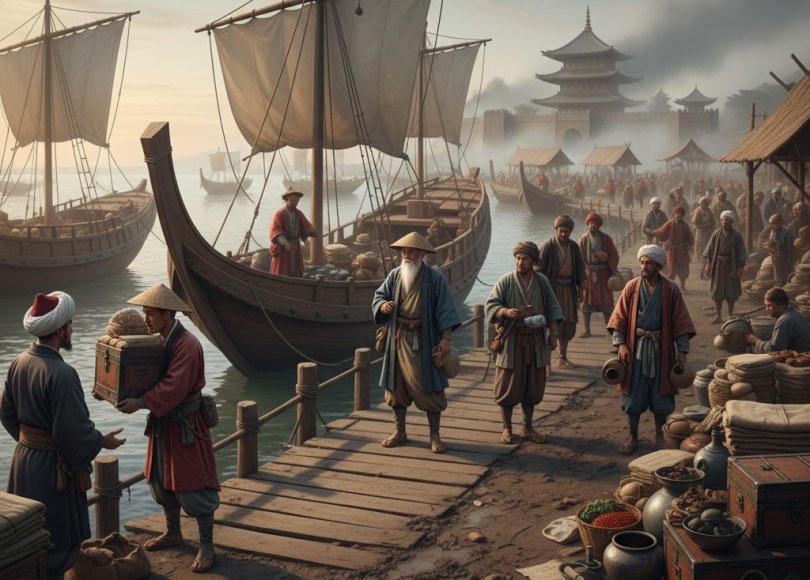
AI created image.
 Let's Dive into Japanese History
You must be logged in to post a comment.